skip to main |
skip to sidebar
We were bused out to the Ring of Brodgar, the finest known circular stone ring from the early Bronze Age.
Six miles north-east of Stromness on the Mainland, are 27 remaining standing stones.
Part of the larger "Heart of Neolithic Orkney," a UNESCO World Heritage Site.
Due to tourists walking around the stones, leading to erosion, they are in the process of installing an underground drainage system.
Dee caught an image that shows the challenges to photographers with a group tour.
But she also got some good shots:
I enjoyed getting close-ups:
Our guide told us there are some sites where the farmers knocked down the stones because they got tired of people tramping all over their property.
The number of Neolithic sites in this area is beyond belief.
Just look at all the dots on this map from August 2014 National Geographic Magazine, when Orkney Stones were on the cover.
Dee got the above shot, from the bus window while driving to the site. And also this one of a mound:
They have found these burial mounds are actually on top of underground temples.
After the Stones, we stopped at Orkney's Italian Chapel.
Built by POWs out of half-cylindrical Nissen huts (similar to Quonset huts). The prisoners were from the Italian Tank Corps.
The Chapel was hand-painted by the inmates of Camp 60 who were brought in to construct a causeway (Churchill Barriers) to block the eastern approach to the British Fleet.
The three-dimensional paintings were so real, it felt like being inside a cathedral. Heading back to town, Dee captured another fish farm:
We took a short walking tour of Kirkwall.
Their Masonic Lodge is the oldest Freemason lodge in Orkney and one of the oldest lodges in Scotland.
The building says 1885, but official records traced the lodge back to October 1, 1736.
 |
| St Magnus Cathedral |
We had the most fun in the grave yard:
Dee's shot of the same fence:
Then we looked up:
Across the street was the ruins of the Bishop's Palace, the residence of the medieval bishops of Orkney.
Around the corner we found a small museum.
That had a great staircase.
More sewer covers:
And disappearing sights:
Before heading back to the ship, we had to sample the local brew:
I like bourbon and have never been able to drink scotch, but our tour guide said this brand had receive top awards in California, three years in a row. I now have a scotch I like:
As we sailed away, we spotted another lighthouse.


 Located in front of the Cathedral:
 Detail on the back pillar:
  Mold on the brick wall:


 It didn’t look open, plus I had read that you need to purchase a tour in order to see the inside.
  I found other interesting sights to photography.


 Two days to Valentine’s Day:
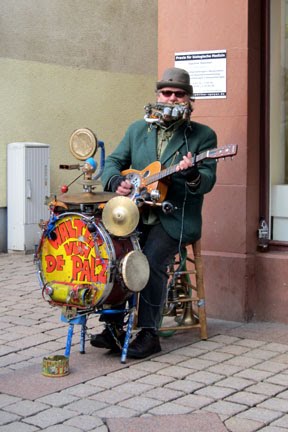
 One-man-band singing Willie Nelson, Bob Dylan & Janis Joplin…with a German accent:
 Part of a fountain that is a memorial to the fallen of WWI.
 Great device…kids sit on them and spin.
 Dreifaltigkeitskirchengemeinde (Trinity Parish), is a Protestant church built between 1701 and 1717.


 While leaving town I found this wonderful sculpture in the center of a traffic circle; the feathers rotate in the wind, like a pinwheel:


